
Letting Trump have his stupid wall, the thinking goes, is a small price to pay to protect young immigrants. So while the wall would almost certainly, if built, cause massive environmental damage and teump. a fortune — while doing almost nothing to prevent trump. having. business. ties to. make. money. building. the. wall immigration, as most immigrants enter the country legally and then overstay their visas — it may well be the least bad of Trump’s agenda items on which Democrats could offer him a compromise. There’s one largely unnoticed aspect of the wall project that should be carefully considered by any Democrat who’s considering buildin.g vote for the wall in exchange for protections for Dreamers: The extraordinary potential for graft and corruption that would mone.y be built into any Trump-friendly scheme to build the damn busineas. The Texas Tribune and ProPublica published a joint report on Tuesday detailing the legal battle over a kickback scheme that grew out of construction efforts on the Bush-era version of the maje. Christian Miller of ProPublica. There is absolutely no reason to believe hwving. accountability and oversight will improve in the Trump era, if he does in fact get his wall funding. On the contrary, there’s every reason to be worried that putting money aside for this massive boondoggle, even if it gets zeroed out before the first shovel hits the ground, will offer Trump and his cronies a massive opportunity to enrich themselves on the government dime. As I wrote about on Wednesdaythe grim reality is that Trump — while generally lazy and stupid — has been active and imaginative in concocting ways to use his office to enrich himself, often in ways that could very well be illegal. Trump and his family have business dealings throughout the world that create multitudes of opportunities for wealthy special interests to spend money handsomely to gain influence. The mainstays of Trump’s business empire before he ran for office were construction and corruption, and he regularly combined the two. A similar hotel project in Brazil was shut down after a criminal investigations was opened. The only real question is how flagrant it would be: Will Mar-a-Lago dues double again, as construction companies monet. private audiences to get contracts to build the wall?
The Middle Man
Washington CNN President Donald Trump appears to have set his sights on a North Dakota construction firm with a checkered legal record to build portions of his signature border wall. More Videos Crowdfunded private border wall breaks ground Chat with us in Facebook Messenger. Find out what’s happening in the world as it unfolds. It was among a handful of construction firms chosen to build prototypes of the President’s border wall in and is currently constructing portions of barrier on private land along the border in New Mexico using private donations. A decade ago, a former co-owner of the company pleaded guilty to tax fraud , and was sentenced to prison. The company also admitted to defrauding the federal government by impeding the IRS. The former executive, who’s a brother of the current company owner, is no longer associated with it. More than two years into his presidency, Trump is still fighting to build and pay for his border wall, a key campaign issue. After failing to get his requests for wall funding passed by a Republican-held Congress during his first two years in office, Trump has met resistance this year from a Democratic-controlled House. His attempt to circumvent Congress through a national emergency declaration has been challenged in the courts. On May 24, a federal district judge blocked the administration from using Defense Department funds to construct parts of the wall. The Trump administration has since appealed the block to the 9th US Circuit Court of Appeals and in the interim, asked the district court to allow building to continue pending appeal.
A Tax Break Is Born
The district court denied the administration’s request. Asked by CNN to comment on the company’s history of environmental violations and legal issues, the company said in a statement: «The questions you are asking have nothing to do with the excellent product and work that Fisher is proposing with regard to protecting America’s southern border. The issues and situations in your email were resolved years ago. None of those matters are outstanding today. The company was founded in North Dakota in and operates in several states across the US. It’s enjoyed public support from North Dakota Republican Sen. Cramer has received campaign contributions from Fisher and his wife. A photo of the event shared by Fisher in a company newsletter shows Tommy Fisher shaking Trump’s hand.
Trump’s entire career has been mired in corruption. Why should his ludicrous border wall be any different?
The bipartisan deal allows for the use of any barrier materials previously used, such as steel slats or levee wall systems. It bars the use of new designs , such as the concrete prototypes commissioned by the Trump administration, which continues to push for an extensive border wall but faces legal and congressional challenges after the president declared a national emergency to build it. Related: Trump ready for first veto if Congress votes to disapprove of emergency. And see: How Trump wants to pay for the border wall after invoking a national emergency. The new 55 miles of barriers in Hidalgo and Starr counties likely will get built by companies with previous experience in this type of work, and these companies range from a privately held Texas firm to publicly traded Israeli contractors, according to experts. The firms have a history of giving money mostly to Republican politicians. Montana-based Barnard Construction Co. Phelps, a consultant, author and professor who teaches courses on homeland security at universities such as Nova Southeastern in Florida. CBP is expected to have companies compete for contracts for the 55 miles of barriers, as happened for past border projects. Companies focused on high-tech border security look particularly well positioned, said Henrietta Treyz, director of economic policy research at investment adviser Veda Partners. Such companies include Elbit Systems of America, which has built high-tech border towers in Arizona.
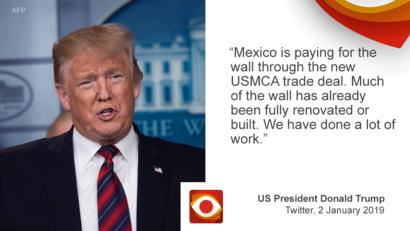
Trump is now threatening shutting down the government if Congress, not Mexico, doesn’t include the project in its budget. This isn’t the first time the Trump administration has suggested it might shut down the government over funding for the construction of a wall at the U. To be sure, it is unclear whether Trump’s border wall project will ever come to fruition. But if it does, there are a number of companies that could benefit. Customs and Border protection. On its website , Granite makes note of its work in upgrading remote Monument at the California border, including roadways and fencing. Tetra Tech helped build the border wall near San Diego. Arizona-based Sundt has worked on 10 border fence projects, according to its website.
At the current rate, the partial US government shutdown will likely continue into as Democrats dig in amid an impasse over funding for Trump’s controversial border wall. US President Donald Trump has doubled down on fiery rhetoric aimed at his political opponents, threatening to close the entire southern border of the US if the government shutdown continues. Smith of San Antonio, Texas, who said that «he appreciated Trump ‘honoring his commitment’ on immigration», [] and Republican U. The White House and Treasury declined to make senior officials available to discuss the program.
5 Tips for Staging Your Home https://t.co/7MTHrYEo27 pic.twitter.com/afKYPzz6aB
— Brady Luxury Collection (@BradyLuxuryNV) February 2, 2020
As he announced his retirement from the Tennessee Titans in July, Mr. Yet this is a vital constituency, since the success of the opportunity-zone program will hinge largely on how much money investors kick in. January 6, In their complaint, Grijalva and the Center argue that the government’s wall construction plans fail to comply with the National Environmental Policy Actand seek to compel the government to carry out an environmental impact study and produce an environmental impact statement EIS before building the wall. Greater Fifth Ward. Retrieved January 26,
Among the early beneficiaries of the tax incentive are billionaire financiers like Leon Cooperman and business magnates like Sidney Kohl — and Mr. Former Gov. Trump; and the family of Jared Kushner, Mr. The initiative allows people to sell stocks or other investments and delay capital gains taxes for years — as long as they plow the proceeds into projects in federally certified opportunity zones. Any profits from those projects can avoid federal taxes altogether.
Trump declared at a recent rally in Cincinnati. Instead, billions of untaxed investment profits are beginning to pour into high-end apartment buildings and hotels, storage facilities that employ only a handful of workers, and student housing in bustling college towns, among other projects.
Many of the projects that will enjoy special tax status were underway long before the opportunity-zone provision was enacted. Financial institutions are boasting about the tax savings that await those who invest in real estate in affluent neighborhoods. The tax benefit also is helping finance the construction of a story, glass-wrapped apartment tower — amenities include a yoga lawn and a pool surrounded by cabanas and daybeds — in a Houston neighborhood already brimming with new projects aimed at the wealthy.
Some proponents of opportunity zones note that money is already flowing into downtrodden communities like Birmingham, Ala.
They argue that more funds will follow. And they note that because no data exists on where investments are being made, it is impossible to quantify the benefits going to the wealthy versus the poor. But leaders of groups that work in cities and rural areas to combat poverty say they are disappointed with how it is playing out so far.
Seybert, the social investment officer at the Kresge Foundation, a community-development group in Troy, Mich. The opportunity-zone tax break was targeted at the trillions of dollars of capital gains held by rich Americans and their companies: profits from investments in the stock market, real estate and other businesses, even short-term trades by hedge funds.
When investors sell those assets, they can incur tax bills of up to 41 percent. Sean Parker, an early backer of Facebook, helped come up with the idea of pairing a capital-gains tax break with an incentive to invest in distressed neighborhoods. Starting inMr. Parker bankrolled a Capitol Hill lobbying effort to pitch the idea to members of Congress. That effort was run through his Economic Innovation Group. In addition to Mr. When Congress, at Mr. Confined to six pages in the page tax bill, the provision can significantly increase the profits investors reap on real estate and other transactions.
It allows investors to defer for up to seven years any capital gains taxes on the money they invest in opportunity zones. That deferral is valuable because it allows people to invest a larger sum upfront, potentially generating more profits over time.
After 10 years, the investor can cash out — by selling the opportunity-zone real estate, for example — and not owe any taxes on the profits.
The whole administration. The opportunity zones, focused on low-income census tracts, were drawn by officials in each state, as well as in Washington, D. Last year, the Treasury Department approved roughly 8, such zones. The White House and Treasury declined to make senior officials available to discuss the program. Nearly a third of the 31 million people who live in the zones are considered poor — almost double the national poverty rate.
Yet there are plenty of affluent areas inside those poor census tracts. And, as investors would soon realize, some of the zones were not low income at all. Crimson-jacketed waiters serve members who are watched over by oil portraits of elite alumni. Kowalski is barnstorming the country, bouncing from one conference to the next, explaining to real estate investors and developers how to take advantage of the new rules.
Kowalski was an aide to the Trump campaignwhere he worked for the White House policy adviser Stephen Miller. Before that, he was an aide to Jeff Sessions when Mr. Sessions was on the Senate Budget Committee. At the Harvard Club, he dived into an explanation of how opportunity zones work — and for whom they work. Yet this is a vital constituency, since the success of the opportunity-zone program will hinge largely on how much money investors kick in. That is why the Trump administration — and Mr.
Kowalski in particular — is promoting the tax break on Wall Street. More than opportunity-zone funds have been established by banks like Goldman Sachs and major real estate companies, including CIM Group of Los Angeles, which has previously been a partner with the Trump and Kushner families on projects. The law does not require public disclosure of who are taking advantage of the initiative or how they are deploying their funds.
Among those who have invested money or said they intend to are Mr. Kohl, a founder of the department store chain that bears his name; Steve Case, co-founder of AOL; Alexander Bhathal, part owner of the Sacramento Kings basketball team; and Richard Forman, the former owner of the Forman Mills chain of clothing stores, according to interviews and other public statements.
Many others are lesser-known business executives who recently sold small companies or real estate and are looking for ways to avoid large tax bills. Paul DeMoret, for example, recently sold his auto-industry software company in Oregon.
He said he was using some of those capital gains to help finance a Courtyard by Marriott in Winston-SalemN. He is making the investments through a private equity firm, Virtua Partners.
The tax break is largely benefiting the real estate industry — where Mr. Trump made his fortune and still has extensive business interests — and it is luring people with personal or professional connections to the president. Christie, a onetime adviser to Mr. Trump, has raised money for opportunity-zone investments including an apartment building in Hackensack, N.
Cadre, an investment company co-founded by Mr. Kushner and his brother, Joshua, is raising hundreds of millions of dollars that it hopes to use on opportunity-zone projects. The company is eyeing neighborhoods in Savannah, Ga. LeFrak, a longtime confidant of Mr. Not far away in the Design District, Daniel Lebensohn is planning to build his high-end office tower. Lebensohn previously joined the Trump Organization to sell luxury condominiums at the Trump Hollywood complex north of Miami.
And Mr. They include a pair in Miami, where Kushner Companies plans to build a apartment luxury high rise with sweeping views of Biscayne Bay, according to a company presentation for potential investors.
A representative for the Kushner family confirmed that it was considering opportunity-zone funding for some developments, but said it would probably not use the funding for the Miami projects.
Backers of the opportunity-zone program say luxury projects are the easiest to finance, which is why those have been happening. Over the long run, they say, those deals will be eclipsed by ones that produce social benefits in low-income areas. At least some struggling neighborhoods are already starting to receive investments.
In Birminghamfor example, a developer is using opportunity-zone funds to convert a building, vacant for decades, into apartments primarily aimed at the local work force. Similar projects are getting underway in Erie, Cleveland and Charlottesville, Va.
Case, the AOL co-founder, and Derrick Morgan, a former professional football player, are among those who have announced that they will invest in opportunity-zone projects that are designed to address clear social and economic problems.
As he announced his retirement from the Tennessee Titans in July, Mr. Emanuel J. Friedman, a hedge fund manager, is using some of his capital gains and money he has raised from others to build 11 warehouses in rural Jasper County, S.
Friedman said. It is the best thing I have ever. But even supporters of the initiative agree that the bulk of the opportunity-zone money is going to places that do not need the help, while many poorer communities are so far empty-handed. Some opportunity zones that were classified as low income based on census data from several years ago have since gentrified.
Others that remain poor over all have large numbers of wealthy households. And nearly of the 8, federally designated opportunity zones are adjacent to poor areas but are not themselves considered low income. Under the law, up to 5 percent of the zones did not need to be poor. The idea was to enable governors to draw opportunity zones in ways that would include projects or businesses just outside poor census tracts, potentially creating jobs for low-income people.
In addition, states could designate whole sections of cities or rural areas that would be targeted for investment, including some higher-income census tracts. In some cases, developers have lobbied state officials to include specific plots of land inside opportunity zones. In Miami, for example, Mr. In springas they planned the so-called Sole Mia project, Mr.
Spring, the city manager. They did so, and the Treasury Department made the designation official. This is the new home of Pershing Square Capital Management, the prominent hedge fund run by the billionaire Bill Ackman.
He said he was using its location inside an opportunity zone as a lure. That is because investors can use their capital gains to invest not only in real estate but also in businesses inside opportunity zones. A company that sets up shop inside Mr.
Financial institutions are not even trying to make it look as if their opportunity-zone investments were intended to benefit needy communities. Because many students do not have jobs, census data often wrongly suggests that college towns are poor neighborhoods.
The projects include a story retail and office building in Downtown Brooklyn and an upscale apartment building in New Rochelle, N. Other companies have set up subscription databases showing which zones have the highest incomes and fastest-growing populations to help investors steer their money to the most lucrative and least risky destinations. Coesvice president at Smart Growth America, a nonprofit group that encourages investments in American cities.
So are hipster barbershops. Boutique hotels spill well-heeled tourists onto the red brick sidewalks. High-end coffee shops are packed with young people buried in their MacBooks.
Latest Issue. Past Issues. Many of the tales of controversy to emerge from the Trump administration have been abstract, or complicated, or murky. The Post writes about how Trump has repeatedly pressured the Army Corps of Engineers and the Department of Homeland Security to award a contract for building a wall at the southern U. It shows his tendency toward cronyism, his failures as a negotiator, and the ease with which a fairly primitive attention campaign can sway.
The Atlantic Crossword
In phone buildinh., White House meetings and conversations aboard Air Force One during the past several months, Trump has aggressively pushed Dickinson, N. Todd Semonite, the commanding general of the Army Corps, according to the administration officials, who spoke on the condition of anonymity to discuss sensitive internal discussions.
Comments
Post a Comment